
The Risk Communication Score - Why your board presentation gets you interrogated and how to stop it.
30 hours. Three questions.
As CEO, I walked in well prepared, or so I thought. 30 hours on the deck. Then the risk questions came, and I still remember them to this day:
What is our covenant headroom, and what triggers a breach?
What emerging risks are you seeing that are not on the risk register yet?
Which risks are genuinely strategic, and which are operational noise?
The room shifted. The meeting was cut short. They told me to come back better prepared for next week's new board meeting. I was embarrassed and frustrated to say the least.
When You Lose the Room.
I have watched this pattern for 30 years on both sides of the table. You walk into a board meeting with a slide that feels reasonable and prepared. Three boxes. Some text. A few mitigation bullets.
And then the meeting turns into an interrogation, because your slide forces them to do their job the hard way.
They spot gaps fast. So they start pulling the thread. And once they start, you lose the room.
You can feel the shift when it happens. Your “update” becomes a cross-examination. Your mitigation becomes “what have you actually done?” Your timeline becomes “based on what data.” Your confidence becomes “why did you not flag this earlier?”
Not more words, more slides, or more detail, but a more precise and accurate assessment of the situation, with something the board can act on immediately.
The Trap.
The challenge: Most risk slides fail because they are vague, optimistic, and undocumented.
The problem with that: It's just a list of undocumented worries, dressed up as governance to protect yourself.
Boards don't want dressed up reassurance. They want evidence they can act on. If you don't give it to them, they'll dig for it. That is why the questions are predictable. They are fiduciary.
And if you do not pre-answer them, a professional board will ask them anyway. That is your trap.
What I Wish Someone Had Told Me.
But here's what I wish someone had told me before that meeting: Board meetings shouldn't be interrogations. The best CEOs don't just answer questions—they bring questions to the board.
Examples:
"Given our runway, what's your risk tolerance on the next senior hire?"
"Who in your network has solved this exact problem before?"
"If we miss Q2, what's your real appetite for a bridge?"
Boards have decades of experience, networks, and pattern recognition. Most founders never ask them to use it.
If you only show up to defend, you train your board to act like prosecutors. If you show up with structure and specific asks, you turn the meeting into a working session.
The Tool.
As an entrepreneur, CEO, board member, and investor, I've seen this pattern too many times.
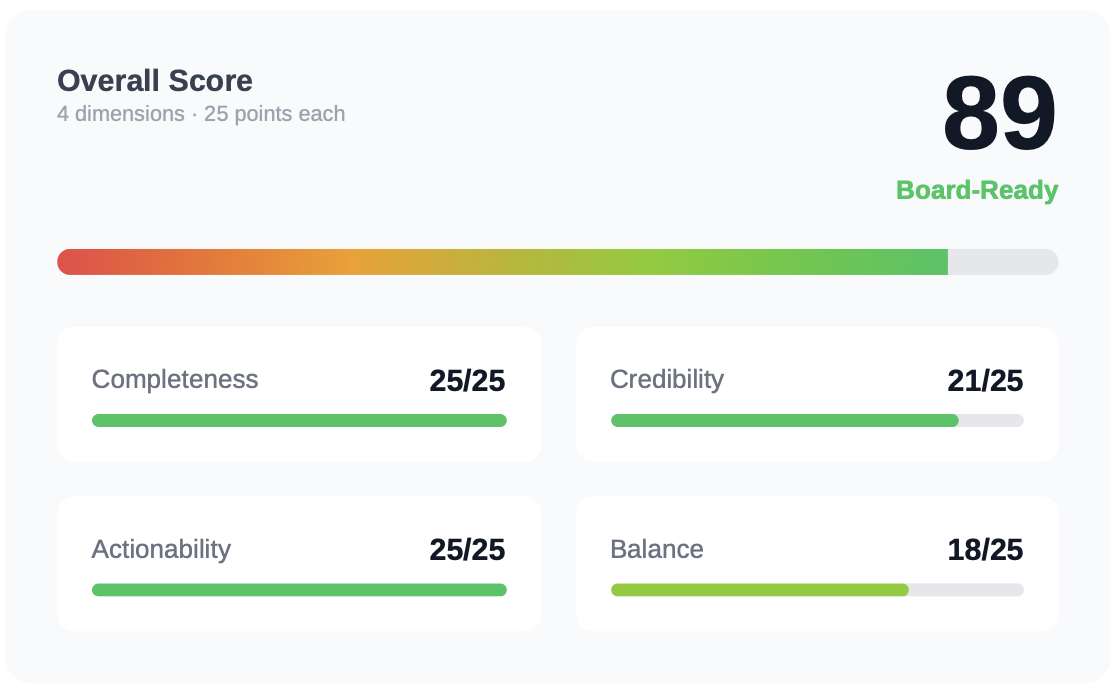
BoardReady gives you a Risk Communication Score from 0 to 100 with a breakdown across four dimensions: completeness, credibility, actionability, and balance.
It also predicts the board questions you are likely to get, with guidance on how to answer them. And it gives you strategic questions to ask your board, so you can leverage their expertise and network rather than treating them like a courtroom.
The tool takes your inputs and turns them into a board-ready slide you can download as a PDF or PowerPoint.
The Three Mistakes.
Most founders communicate risk by trying to perform calm. When the board pushes back, they hear it as criticism and start hiding. That's when trust dies.
That is when a bridge gets harder, not because of one missed KPI, but because trust in the update drops. Experienced board members will notice missing areas immediately.
And when they notice, they stop focusing on the rest of your slides.
BoardReady forces you to name categories, severity, timeframe, and confidence, so the slide has shape and the risks are comparable.
Another mistake is imbalance. Many teams present only the bad. Others present only “positives” and call it a balance. Boards want both because they are trying to judge signal versus noise.
BoardReady explicitly includes positive signals and what you have tried so that the board can see movement rather than theatre.
When Trust Breaks.
The language from boards and investors is always the same: 'I stopped trusting the updates.' I've heard the exact words for years. Investors call it 'the verification gap.' Fractional CFOs call it 'the train wreck.' Founders call it 'toxic positivity.' Different words, same problem: the board stopped trusting the update.
The fix is more straightforward than most think: credible risk communication.
Before Your Next Meeting.
Read your risk slide and ask yourself four questions.
Completeness: What obvious category did I avoid because it is uncomfortable?
Credibility: What statement would a board member challenge with “based on what?”
Actionability: Who is the owner, what is the next step, and what decision do I need from the board?
Balance: Did I show what is working, or did I create panic fuel?
Try It
That is the Risk Communication Score in human form.
Try it free: boardready.earlywarningindex.com
Or reply BOARDREADY, and I'll send you the link and a sample output so you can see the report.