
The Pre-Mortem Kill Switch
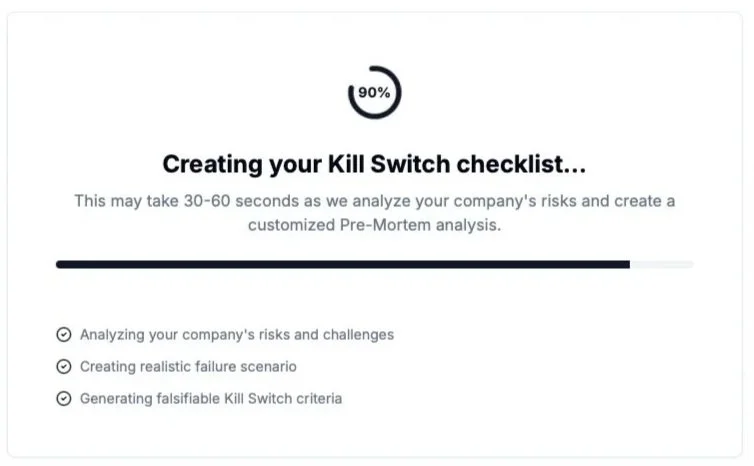
The tool generates your failure scenario and Kill Switch checklist in under a minute.
Takeaway
Most business failures are explained clearly after the fact. Few are analysed seriously before decisions are locked in.
A pre-mortem helps boards and investors identify how a company could fail while there is still time to act.
Normalisation of deviance causes early warning signs to be ignored when performance still looks acceptable.
Written failure scenarios and explicit kill switch criteria turn vague concerns into concrete decision points.
The Pre-Mortem Generator is a free tool to support early risk detection and board level decision making.
The Pre-Mortem:
Most boards and investors are very good at one thing after a crisis:
Saying what went wrong.
Everyone can explain why it went wrong after the money is gone, the team is tired, and the customers have left.
Very few do the work before.
I built a free tool called the Pre-Mortem Generator at premortem.earlywarningindex.com. It writes a realistic “company obituary” and a Kill Switch checklist before you end up there.
When shortcuts become the standard
Normalisation of deviance is a heavy term for a simple thing:
- Small “rule breaks” slowly turn into normal practice.
What starts as “just this once” becomes “this is how we do it”.
You see it all the time.
Standards that were once strict get bent to hit a deadline.
Compliance rules are “interpreted” so a deal can close.
A board tolerates behaviour today that it would never have accepted two years ago.
There is no big decision to lower the bar.
People are busy. Targets are tight. Nobody wants to be the one who slows things down.
In risk research, this slow slide is called normalisation of deviance.
“We do not recognise that picture”
One of the first things I look for in potential future crises is how founders, management and investors talk about the company after 6, 12 or 24 months.
Do they describe the real problems in the same way?
Do they have the same idea of what is working and what is not?
Do they agree on what happens next if the plan fails?
When I walk investors and founders through that picture, most of them say the same thing:
“That is not us.”
“We do not recognise that.”
Then we look at the facts:
90% of businesses eventually fail.
75% of investments never return any capital
80% of us are overestimating our own and the business's capabilities.
I can go on, anyway, on paper, everyone knows this.
In the room, however, most still behave as if they will be the exception.
The problem is rarely a lack of intelligence or effort, but the refusal to look at the situation with clear eyes and accept the consequences.
Post-mortems are cheap wisdom bought at a high price.
I first learned it in sales.
We did post-mortems on lost deals. We looked at what went wrong and what we should do differently next time.
At some point, we flipped the question.
Before big deals, we asked:
“If we lose this, why will we lose it?” Identify red flags.
A somewhat weird but very useful exercise. We could still change the outcome.
The same logic applies to companies, not only deals.
Boards are full of smart people who are willing to sit for hours in a post-mortem.
Very few spend ten quiet minutes on a simple pre-mortem.
That is the gap I wanted to close when I built the Pre-Mortem Generator.
What the Pre-Mortem Generator does
The Pre-Mortem Generator is built for angels, VCs, board members and founders.
You answer a short set of questions about:
- the company stage
- current cash flow and runway
- the main risks you see
- any major change in strategy or spending you are considering
Based on that, the tool gives you two things.
1) First, a written failure scenario:
A “company obituary” that describes how the company could realistically end up in trouble if you continue on the current path.
2) Second, a kill switch checklist:
Concrete criteria that tell you when to pause, slow down or stop.
For example, triggers around customer loss, hiring, cash, dependency on single people, or regulatory issues.
It takes a few minutes to fill out.
You get a text you can read yourself, share with the founder, or bring straight into the next board or investment meeting.
The method behind it comes from Gary Klein’s work on pre-mortems and Diane Vaughan’s work on normalisation of deviance, but the output is written in plain language for everyday use.
The real resistance
The main barrier is not time but emotions.
Typical thoughts:
“If this report looks bad, it will reflect on me as an investor or leader.”
“The management is already under pressure. I do not want to worry them more.”
“We already know our risks. A tool will not tell us anything new.”
I understand that. I have sat in those rooms and had the same thoughts.
But if the goal is to protect capital, jobs and reputation, then not looking is the most expensive choice you can make.
Businesses using external early detection are 76% more likely to succeed.
A tool like this does not care whose idea it was or who sits on which side of the table. It just mirrors what you put in and forces a reaction.
Sometimes the “worst” outcome is that the report confirms what you already knew.
Then at least the conversation is based on something written and specific, not on vague feelings and optimism.
How to use it
A few simple ways angels, VCs and boards use the Pre Mortem Generator:
Before signing off on a major change to a product, market, or spending.
Before putting more money into a company where something feels off.
As a quarterly “fire drill” on the most important portfolio companies.
As a neutral starting point, when founders and boards do not agree on how serious the situation is.
Run it individually first. Then share it with your board, founder, etc.
The gaps between what people notice are often more important than the report itself.
The Early Warning Index examines behaviour, decisions, and financials here and now and over time.
The Pre-Mortem Generator examines where those patterns could lead if no one changes course.
Try it and tell me what surprised you.
The tool is free to use.
It is available in Danish and English at premortem.earlywarningindex.com.
Disclaimer:
The failure scenarios are hypothetical.
They are not predictions.
They are written to help you see patterns and consequences from another angle.
If you run it on a company or an investment, I am curious about two things:
- What in the “company obituary” felt uncomfortably close to home
- Which kill switch trigger did you decide to watch from now on
You can write to me or comment with what you can share.
Post-mortems will always be written.
The question is: how many of them could you have avoided with a short pre-mortem?